

Friday, January 10, 2014
Thursday, January 9, 2014
WHEN WE RULED...EXCERPT.
Moorish Impetus to European Renaissance: excerpts from “The Civilization of the Moors,” in WHEN WE RULED: THE ANCIENT AND MEDIEVAL HISTORY OF BLACK CIVILIZATION by Robin Walker (Every Generation Media, Ltd., London UK: 2006) pp. 398, 399, 402, 406-407, 410, 412-414, 417 “By 500 AD the western part of the Roman Empire was in decline. This was of some importance since the Romans carried the flame of civilization in Europe. Europe therefore entered an unhappy period known as the Dark Ages. This period lasted until 1100 AD. …
“The term ‘Dark Ages’ only applied to Europe. The rest of the world was not necessarily in a dark age. The Dark Age period of European Christendom actually corresponds to the Golden Age of Islamic Civilization. The Muslim city of Cordova in Spain was much like a modern city by at least 950 AD. It boasted paved streets drained by sewers, raise pavements and street lamps…
“This wonderful city [Cordova] had a population of at least one million, housed in 200,000 properties and 60,000 mansions and palaces. Of two stories, the grander homes boasted latrines and running water. Fine gardens surrounded the larger buildings. There were 900 public baths and many private baths, not to mention 800 public schools and many colleges. Education was universal, being offered to girls as well as boys. Over 1,000 mosques flourished, of which one, the Grand Mosque, is among the great buildings of the world… Of trade, the Cordovans had access to over 4,000 markets and 80,000 shops. They could buy Chinese tea, Indian spices, Russian furs, African ebony and ivory, and locally made goods. A massive wall measuring fourteen miles encircled this busy seven-gated city.
“The Arab invasion of North Africa was of great consequence. Many Africans fled south from North Africa to lands south of the Sahara. Those that remained were converted to Islam. The Arabs occupied Egypt in 639 AD, Tripoli in 643, and southwest Morocco y 681. In 698 they appointed the Yemeni, Musa ibn Nusair, Governor of North Africa….
“Apart from the Umayyad sultans, who could have been of any ethnicity, the overwhelming majority in the country were Africans. Professor Stanley Lane-Poole wrote that: ‘The Berbers were more numerous than the Arabs. Sharing this view Professor Jackson wrote that the Arabs ‘were always a minority in the so-called Arab culture of the Middle Ages.’…
“In 912 AD Abd-al-Rahman III became ruler of Spain, starting a second period of achievement. By the following year, he seized Seville. Years later he captured Merida… In Africa he was proclaimed ruler of Mauritania and Fez, thus establishing the Empire of The Two Shores with a court in Africa and one in Spain….Trade developed by the encouragement of agriculture through extensive irrigation, exploitation of mineral resources of the land, and trade concessions for the Jews. Finally, he built the palace-city of Medina al-Zahra and gathered poets and scholars at his residence.
“Al-Hakam II succeeded him in 961 AD and ruled for a creditable fifteen years. As crown prince, he was fond of books, scientists and scholars. On the throne, he sent agents across the Islamic world to procure books and compendia. He gave the agents large budgets to spend on scribes, scholars and copyists. In a Cordovan library, the sultan gathered 400,000 books accompanied by 44 volumes of indexes. In addition, he commissioned scholars to write books on ethics, statecraft and genealogy. He encouraged the study of geography, agriculture, astronomy, medicine, philosophy, and mathematics. Moreover, he established schools and centres of learning for people of all social classes. ..
“At this time, a number of houses of learning were established in Christian Europe. There was one in Barcelona, Toulouse, Marseilles, Leon, Segovia, etc. They existed to translate Moorish and Arab texts from the original Arabic to Latin….
“The Almoravides probably introduced golden coinage into Europe. From the twelfth century, the Christian Spaniards minted golden coinage in imitation of Almoravid coins. The following century, mints in Florence, Genoa, Marseilles, and Venice turned out golden coinage in imitation of the Christian Spaniards. In the fourteenth century, golden coinage makes its appearance in parts of northern Europe. According to Al-Idrissi, Wangaran (i.e. Guinean) gold was minted at some lace ‘in the extreme west of Africa’ in the twelfth century and put into circulation. This may well have been the source of the Almoravid coins.
“Ali ibn Yusuf, son of Yusuf ibn Tashifin, ruled from 1106. As ruler his thinking was very much guided by the ideas of legal scholars of the time. These scholars, however, had become very conservative and traditionally minded. They objected to the ‘new’ ideas of Cordovan philosopher Al-Ghazzali. Following their lead, Ali had Al-Ghazzali’s books burned. As ever, challenges came from Christians to the north. ..The earldom of Portugal became independent in 1139. This territory later expanded into a kingdom…
“Ad-al-Mumin, another Mesmuda Berber, took control of the movement in 1133. A brilliant organizer, he unified the various Berber groups, not just the Mesmuda, into a cohesive force…In 1147 they seized Marrakech and executed the last Almoravid monarch… By 1150 he became the master of Spain. ‘Thus for a second time’ wrote Lady Lugard, ‘a purely African dynasty reigned upon the most civilized throne of Europe.’ By 1160 his armies took control of Tunisia and penetrated Libya. These actions gained control of trade routes. Dr. Basil Davidson explained that: ‘the Magreb blossomed once again.’ Moreover, ‘cities like Fez and Tlemsen [sic] rivalled the urban beauty and learning of Granada and Cordova, unsurpassed by now throughout the western world.’
“Abu Yakub Yusuf became the next ruler in 1163. Like his father, he ruled the Almohad Empire mostly from Marrakech in Morocco. Taking scholarship seriously, he funded the greatest Islamic thinker of the age—Ibn Rushd (also called Averroes). He appointed the great thinker to the post of High Court Judge in Cordova. Additionally, he appointed Ibn Tufail, another great scholar of the time, to be his personal doctor and prime-minister in Marrakech. He also began the transformation of the city of Seville into a great and prosperous city….
“From 1086 to 1248 this city [Seville] stood at the heart of the Moorish administrative machine. Even today the faint echo of the African presence is seen in the standing monuments of the city and is even on the complexions of the Seville population…
“Seville had an impressive reputation for science and art that was second only to that of Cordova. Even bishops of Christ flocked to its university to study. Of the great scholars of the city were Al Begi the Sage; Al Idrissi, author of an encyclopedia of the sciences; and Averroes, the great philosopher.
“In the early thirteenth century, however, things fell apart. Again, there was African and Arab disunity, caused by Arab prejudice. Arab poet, Abu Ga’far, for example, refused the post of Secretary of Granada, because he did not wish to work alongside Sultan Abd-al-Mumin’s son. Abu Ga’far felt that ‘the dark-sinned Berber seemed to him far below his own intellectual standards.’
“Meanwhile, the European translation centers of Moorish and Arabic texts, established in the tenth century, had borne fruit. By the twelfth and thirteenth centuries there was the rise of the major European Universities. Bologna University (Italy) was established in 1158, Montpellier (France) in 1180, Oxford (England) in 1200, Toulouse (France) in 1223, Rome (Italy) in 1245 and Cambridge (England) in 1257. Arguably this process began the genesis of the European Renaissance.”
“By 500 AD the western part of the Roman Empire was in decline. This was of some importance since the Romans carried the flame of civilization in Europe. Europe therefore entered an unhappy period known as the Dark Ages. This period lasted until 1100 AD. …
“The term ‘Dark Ages’ only applied to Europe. The rest of the world was not necessarily in a dark age. The Dark Age period of European Christendom actually corresponds to the Golden Age of Islamic Civilization. The Muslim city of Cordova in Spain was much like a modern city by at least 950 AD. It boasted paved streets drained by sewers, raise pavements and street lamps…
“This wonderful city [Cordova] had a population of at least one million, housed in 200,000 properties and 60,000 mansions and palaces. Of two stories, the grander homes boasted latrines and running water. Fine gardens surrounded the larger buildings. There were 900 public baths and many private baths, not to mention 800 public schools and many colleges. Education was universal, being offered to girls as well as boys. Over 1,000 mosques flourished, of which one, the Grand Mosque, is among the great buildings of the world… Of trade, the Cordovans had access to over 4,000 markets and 80,000 shops. They could buy Chinese tea, Indian spices, Russian furs, African ebony and ivory, and locally made goods. A massive wall measuring fourteen miles encircled this busy seven-gated city.
“The Arab invasion of North Africa was of great consequence. Many Africans fled south from North Africa to lands south of the Sahara. Those that remained were converted to Islam. The Arabs occupied Egypt in 639 AD, Tripoli in 643, and southwest Morocco y 681. In 698 they appointed the Yemeni, Musa ibn Nusair, Governor of North Africa….
“Apart from the Umayyad sultans, who could have been of any ethnicity, the overwhelming majority in the country were Africans. Professor Stanley Lane-Poole wrote that: ‘The Berbers were more numerous than the Arabs. Sharing this view Professor Jackson wrote that the Arabs ‘were always a minority in the so-called Arab culture of the Middle Ages.’…
“In 912 AD Abd-al-Rahman III became ruler of Spain, starting a second period of achievement. By the following year, he seized Seville. Years later he captured Merida… In Africa he was proclaimed ruler of Mauritania and Fez, thus establishing the Empire of The Two Shores with a court in Africa and one in Spain….Trade developed by the encouragement of agriculture through extensive irrigation, exploitation of mineral resources of the land, and trade concessions for the Jews. Finally, he built the palace-city of Medina al-Zahra and gathered poets and scholars at his residence.
“Al-Hakam II succeeded him in 961 AD and ruled for a creditable fifteen years. As crown prince, he was fond of books, scientists and scholars. On the throne, he sent agents across the Islamic world to procure books and compendia. He gave the agents large budgets to spend on scribes, scholars and copyists. In a Cordovan library, the sultan gathered 400,000 books accompanied by 44 volumes of indexes. In addition, he commissioned scholars to write books on ethics, statecraft and genealogy. He encouraged the study of geography, agriculture, astronomy, medicine, philosophy, and mathematics. Moreover, he established schools and centres of learning for people of all social classes. ..
“At this time, a number of houses of learning were established in Christian Europe. There was one in Barcelona, Toulouse, Marseilles, Leon, Segovia, etc. They existed to translate Moorish and Arab texts from the original Arabic to Latin….
“The Almoravides probably introduced golden coinage into Europe. From the twelfth century, the Christian Spaniards minted golden coinage in imitation of Almoravid coins. The following century, mints in Florence, Genoa, Marseilles, and Venice turned out golden coinage in imitation of the Christian Spaniards. In the fourteenth century, golden coinage makes its appearance in parts of northern Europe. According to Al-Idrissi, Wangaran (i.e. Guinean) gold was minted at some lace ‘in the extreme west of Africa’ in the twelfth century and put into circulation. This may well have been the source of the Almoravid coins.
“Ali ibn Yusuf, son of Yusuf ibn Tashifin, ruled from 1106. As ruler his thinking was very much guided by the ideas of legal scholars of the time. These scholars, however, had become very conservative and traditionally minded. They objected to the ‘new’ ideas of Cordovan philosopher Al-Ghazzali. Following their lead, Ali had Al-Ghazzali’s books burned. As ever, challenges came from Christians to the north. ..The earldom of Portugal became independent in 1139. This territory later expanded into a kingdom…
“Ad-al-Mumin, another Mesmuda Berber, took control of the movement in 1133. A brilliant organizer, he unified the various Berber groups, not just the Mesmuda, into a cohesive force…In 1147 they seized Marrakech and executed the last Almoravid monarch… By 1150 he became the master of Spain. ‘Thus for a second time’ wrote Lady Lugard, ‘a purely African dynasty reigned upon the most civilized throne of Europe.’ By 1160 his armies took control of Tunisia and penetrated Libya. These actions gained control of trade routes. Dr. Basil Davidson explained that: ‘the Magreb blossomed once again.’ Moreover, ‘cities like Fez and Tlemsen [sic] rivalled the urban beauty and learning of Granada and Cordova, unsurpassed by now throughout the western world.’
“Abu Yakub Yusuf became the next ruler in 1163. Like his father, he ruled the Almohad Empire mostly from Marrakech in Morocco. Taking scholarship seriously, he funded the greatest Islamic thinker of the age—Ibn Rushd (also called Averroes). He appointed the great thinker to the post of High Court Judge in Cordova. Additionally, he appointed Ibn Tufail, another great scholar of the time, to be his personal doctor and prime-minister in Marrakech. He also began the transformation of the city of Seville into a great and prosperous city….
“From 1086 to 1248 this city [Seville] stood at the heart of the Moorish administrative machine. Even today the faint echo of the African presence is seen in the standing monuments of the city and is even on the complexions of the Seville population…
“Seville had an impressive reputation for science and art that was second only to that of Cordova. Even bishops of Christ flocked to its university to study. Of the great scholars of the city were Al Begi the Sage; Al Idrissi, author of an encyclopedia of the sciences; and Averroes, the great philosopher.
“In the early thirteenth century, however, things fell apart. Again, there was African and Arab disunity, caused by Arab prejudice. Arab poet, Abu Ga’far, for example, refused the post of Secretary of Granada, because he did not wish to work alongside Sultan Abd-al-Mumin’s son. Abu Ga’far felt that ‘the dark-sinned Berber seemed to him far below his own intellectual standards.’
“Meanwhile, the European translation centers of Moorish and Arabic texts, established in the tenth century, had borne fruit. By the twelfth and thirteenth centuries there was the rise of the major European Universities. Bologna University (Italy) was established in 1158, Montpellier (France) in 1180, Oxford (England) in 1200, Toulouse (France) in 1223, Rome (Italy) in 1245 and Cambridge (England) in 1257. Arguably this process began the genesis of the European Renaissance.”
 “By 500 AD the western part of the Roman Empire was in decline. This was of some importance since the Romans carried the flame of civilization in Europe. Europe therefore entered an unhappy period known as the Dark Ages. This period lasted until 1100 AD. …
“The term ‘Dark Ages’ only applied to Europe. The rest of the world was not necessarily in a dark age. The Dark Age period of European Christendom actually corresponds to the Golden Age of Islamic Civilization. The Muslim city of Cordova in Spain was much like a modern city by at least 950 AD. It boasted paved streets drained by sewers, raise pavements and street lamps…
“This wonderful city [Cordova] had a population of at least one million, housed in 200,000 properties and 60,000 mansions and palaces. Of two stories, the grander homes boasted latrines and running water. Fine gardens surrounded the larger buildings. There were 900 public baths and many private baths, not to mention 800 public schools and many colleges. Education was universal, being offered to girls as well as boys. Over 1,000 mosques flourished, of which one, the Grand Mosque, is among the great buildings of the world… Of trade, the Cordovans had access to over 4,000 markets and 80,000 shops. They could buy Chinese tea, Indian spices, Russian furs, African ebony and ivory, and locally made goods. A massive wall measuring fourteen miles encircled this busy seven-gated city.
“The Arab invasion of North Africa was of great consequence. Many Africans fled south from North Africa to lands south of the Sahara. Those that remained were converted to Islam. The Arabs occupied Egypt in 639 AD, Tripoli in 643, and southwest Morocco y 681. In 698 they appointed the Yemeni, Musa ibn Nusair, Governor of North Africa….
“Apart from the Umayyad sultans, who could have been of any ethnicity, the overwhelming majority in the country were Africans. Professor Stanley Lane-Poole wrote that: ‘The Berbers were more numerous than the Arabs. Sharing this view Professor Jackson wrote that the Arabs ‘were always a minority in the so-called Arab culture of the Middle Ages.’…
“In 912 AD Abd-al-Rahman III became ruler of Spain, starting a second period of achievement. By the following year, he seized Seville. Years later he captured Merida… In Africa he was proclaimed ruler of Mauritania and Fez, thus establishing the Empire of The Two Shores with a court in Africa and one in Spain….Trade developed by the encouragement of agriculture through extensive irrigation, exploitation of mineral resources of the land, and trade concessions for the Jews. Finally, he built the palace-city of Medina al-Zahra and gathered poets and scholars at his residence.
“Al-Hakam II succeeded him in 961 AD and ruled for a creditable fifteen years. As crown prince, he was fond of books, scientists and scholars. On the throne, he sent agents across the Islamic world to procure books and compendia. He gave the agents large budgets to spend on scribes, scholars and copyists. In a Cordovan library, the sultan gathered 400,000 books accompanied by 44 volumes of indexes. In addition, he commissioned scholars to write books on ethics, statecraft and genealogy. He encouraged the study of geography, agriculture, astronomy, medicine, philosophy, and mathematics. Moreover, he established schools and centres of learning for people of all social classes. ..
“At this time, a number of houses of learning were established in Christian Europe. There was one in Barcelona, Toulouse, Marseilles, Leon, Segovia, etc. They existed to translate Moorish and Arab texts from the original Arabic to Latin….
“The Almoravides probably introduced golden coinage into Europe. From the twelfth century, the Christian Spaniards minted golden coinage in imitation of Almoravid coins. The following century, mints in Florence, Genoa, Marseilles, and Venice turned out golden coinage in imitation of the Christian Spaniards. In the fourteenth century, golden coinage makes its appearance in parts of northern Europe. According to Al-Idrissi, Wangaran (i.e. Guinean) gold was minted at some lace ‘in the extreme west of Africa’ in the twelfth century and put into circulation. This may well have been the source of the Almoravid coins.
“Ali ibn Yusuf, son of Yusuf ibn Tashifin, ruled from 1106. As ruler his thinking was very much guided by the ideas of legal scholars of the time. These scholars, however, had become very conservative and traditionally minded. They objected to the ‘new’ ideas of Cordovan philosopher Al-Ghazzali. Following their lead, Ali had Al-Ghazzali’s books burned. As ever, challenges came from Christians to the north. ..The earldom of Portugal became independent in 1139. This territory later expanded into a kingdom…
“Ad-al-Mumin, another Mesmuda Berber, took control of the movement in 1133. A brilliant organizer, he unified the various Berber groups, not just the Mesmuda, into a cohesive force…In 1147 they seized Marrakech and executed the last Almoravid monarch… By 1150 he became the master of Spain. ‘Thus for a second time’ wrote Lady Lugard, ‘a purely African dynasty reigned upon the most civilized throne of Europe.’ By 1160 his armies took control of Tunisia and penetrated Libya. These actions gained control of trade routes. Dr. Basil Davidson explained that: ‘the Magreb blossomed once again.’ Moreover, ‘cities like Fez and Tlemsen [sic] rivalled the urban beauty and learning of Granada and Cordova, unsurpassed by now throughout the western world.’
“Abu Yakub Yusuf became the next ruler in 1163. Like his father, he ruled the Almohad Empire mostly from Marrakech in Morocco. Taking scholarship seriously, he funded the greatest Islamic thinker of the age—Ibn Rushd (also called Averroes). He appointed the great thinker to the post of High Court Judge in Cordova. Additionally, he appointed Ibn Tufail, another great scholar of the time, to be his personal doctor and prime-minister in Marrakech. He also began the transformation of the city of Seville into a great and prosperous city….
“From 1086 to 1248 this city [Seville] stood at the heart of the Moorish administrative machine. Even today the faint echo of the African presence is seen in the standing monuments of the city and is even on the complexions of the Seville population…
“Seville had an impressive reputation for science and art that was second only to that of Cordova. Even bishops of Christ flocked to its university to study. Of the great scholars of the city were Al Begi the Sage; Al Idrissi, author of an encyclopedia of the sciences; and Averroes, the great philosopher.
“In the early thirteenth century, however, things fell apart. Again, there was African and Arab disunity, caused by Arab prejudice. Arab poet, Abu Ga’far, for example, refused the post of Secretary of Granada, because he did not wish to work alongside Sultan Abd-al-Mumin’s son. Abu Ga’far felt that ‘the dark-sinned Berber seemed to him far below his own intellectual standards.’
“Meanwhile, the European translation centers of Moorish and Arabic texts, established in the tenth century, had borne fruit. By the twelfth and thirteenth centuries there was the rise of the major European Universities. Bologna University (Italy) was established in 1158, Montpellier (France) in 1180, Oxford (England) in 1200, Toulouse (France) in 1223, Rome (Italy) in 1245 and Cambridge (England) in 1257. Arguably this process began the genesis of the European Renaissance.”
“By 500 AD the western part of the Roman Empire was in decline. This was of some importance since the Romans carried the flame of civilization in Europe. Europe therefore entered an unhappy period known as the Dark Ages. This period lasted until 1100 AD. …
“The term ‘Dark Ages’ only applied to Europe. The rest of the world was not necessarily in a dark age. The Dark Age period of European Christendom actually corresponds to the Golden Age of Islamic Civilization. The Muslim city of Cordova in Spain was much like a modern city by at least 950 AD. It boasted paved streets drained by sewers, raise pavements and street lamps…
“This wonderful city [Cordova] had a population of at least one million, housed in 200,000 properties and 60,000 mansions and palaces. Of two stories, the grander homes boasted latrines and running water. Fine gardens surrounded the larger buildings. There were 900 public baths and many private baths, not to mention 800 public schools and many colleges. Education was universal, being offered to girls as well as boys. Over 1,000 mosques flourished, of which one, the Grand Mosque, is among the great buildings of the world… Of trade, the Cordovans had access to over 4,000 markets and 80,000 shops. They could buy Chinese tea, Indian spices, Russian furs, African ebony and ivory, and locally made goods. A massive wall measuring fourteen miles encircled this busy seven-gated city.
“The Arab invasion of North Africa was of great consequence. Many Africans fled south from North Africa to lands south of the Sahara. Those that remained were converted to Islam. The Arabs occupied Egypt in 639 AD, Tripoli in 643, and southwest Morocco y 681. In 698 they appointed the Yemeni, Musa ibn Nusair, Governor of North Africa….
“Apart from the Umayyad sultans, who could have been of any ethnicity, the overwhelming majority in the country were Africans. Professor Stanley Lane-Poole wrote that: ‘The Berbers were more numerous than the Arabs. Sharing this view Professor Jackson wrote that the Arabs ‘were always a minority in the so-called Arab culture of the Middle Ages.’…
“In 912 AD Abd-al-Rahman III became ruler of Spain, starting a second period of achievement. By the following year, he seized Seville. Years later he captured Merida… In Africa he was proclaimed ruler of Mauritania and Fez, thus establishing the Empire of The Two Shores with a court in Africa and one in Spain….Trade developed by the encouragement of agriculture through extensive irrigation, exploitation of mineral resources of the land, and trade concessions for the Jews. Finally, he built the palace-city of Medina al-Zahra and gathered poets and scholars at his residence.
“Al-Hakam II succeeded him in 961 AD and ruled for a creditable fifteen years. As crown prince, he was fond of books, scientists and scholars. On the throne, he sent agents across the Islamic world to procure books and compendia. He gave the agents large budgets to spend on scribes, scholars and copyists. In a Cordovan library, the sultan gathered 400,000 books accompanied by 44 volumes of indexes. In addition, he commissioned scholars to write books on ethics, statecraft and genealogy. He encouraged the study of geography, agriculture, astronomy, medicine, philosophy, and mathematics. Moreover, he established schools and centres of learning for people of all social classes. ..
“At this time, a number of houses of learning were established in Christian Europe. There was one in Barcelona, Toulouse, Marseilles, Leon, Segovia, etc. They existed to translate Moorish and Arab texts from the original Arabic to Latin….
“The Almoravides probably introduced golden coinage into Europe. From the twelfth century, the Christian Spaniards minted golden coinage in imitation of Almoravid coins. The following century, mints in Florence, Genoa, Marseilles, and Venice turned out golden coinage in imitation of the Christian Spaniards. In the fourteenth century, golden coinage makes its appearance in parts of northern Europe. According to Al-Idrissi, Wangaran (i.e. Guinean) gold was minted at some lace ‘in the extreme west of Africa’ in the twelfth century and put into circulation. This may well have been the source of the Almoravid coins.
“Ali ibn Yusuf, son of Yusuf ibn Tashifin, ruled from 1106. As ruler his thinking was very much guided by the ideas of legal scholars of the time. These scholars, however, had become very conservative and traditionally minded. They objected to the ‘new’ ideas of Cordovan philosopher Al-Ghazzali. Following their lead, Ali had Al-Ghazzali’s books burned. As ever, challenges came from Christians to the north. ..The earldom of Portugal became independent in 1139. This territory later expanded into a kingdom…
“Ad-al-Mumin, another Mesmuda Berber, took control of the movement in 1133. A brilliant organizer, he unified the various Berber groups, not just the Mesmuda, into a cohesive force…In 1147 they seized Marrakech and executed the last Almoravid monarch… By 1150 he became the master of Spain. ‘Thus for a second time’ wrote Lady Lugard, ‘a purely African dynasty reigned upon the most civilized throne of Europe.’ By 1160 his armies took control of Tunisia and penetrated Libya. These actions gained control of trade routes. Dr. Basil Davidson explained that: ‘the Magreb blossomed once again.’ Moreover, ‘cities like Fez and Tlemsen [sic] rivalled the urban beauty and learning of Granada and Cordova, unsurpassed by now throughout the western world.’
“Abu Yakub Yusuf became the next ruler in 1163. Like his father, he ruled the Almohad Empire mostly from Marrakech in Morocco. Taking scholarship seriously, he funded the greatest Islamic thinker of the age—Ibn Rushd (also called Averroes). He appointed the great thinker to the post of High Court Judge in Cordova. Additionally, he appointed Ibn Tufail, another great scholar of the time, to be his personal doctor and prime-minister in Marrakech. He also began the transformation of the city of Seville into a great and prosperous city….
“From 1086 to 1248 this city [Seville] stood at the heart of the Moorish administrative machine. Even today the faint echo of the African presence is seen in the standing monuments of the city and is even on the complexions of the Seville population…
“Seville had an impressive reputation for science and art that was second only to that of Cordova. Even bishops of Christ flocked to its university to study. Of the great scholars of the city were Al Begi the Sage; Al Idrissi, author of an encyclopedia of the sciences; and Averroes, the great philosopher.
“In the early thirteenth century, however, things fell apart. Again, there was African and Arab disunity, caused by Arab prejudice. Arab poet, Abu Ga’far, for example, refused the post of Secretary of Granada, because he did not wish to work alongside Sultan Abd-al-Mumin’s son. Abu Ga’far felt that ‘the dark-sinned Berber seemed to him far below his own intellectual standards.’
“Meanwhile, the European translation centers of Moorish and Arabic texts, established in the tenth century, had borne fruit. By the twelfth and thirteenth centuries there was the rise of the major European Universities. Bologna University (Italy) was established in 1158, Montpellier (France) in 1180, Oxford (England) in 1200, Toulouse (France) in 1223, Rome (Italy) in 1245 and Cambridge (England) in 1257. Arguably this process began the genesis of the European Renaissance.”


Wednesday, January 8, 2014


RELATIVITY...EXCERPT
Relativity: The General and Special Theory, “Part I. The Special Theory of Relativity; Physical Meaning of Geometrical Propositions,” by Albert Einstein (Forgotten Books: 1920, 2012), p.1-4
“Geometry sets out from certain conceptions such as ‘plane,’ ‘point,’ and ‘straight line,’ with which we are able to associate more or less definite ideas, and [form] certain simple propositions (axioms) which, in virtue of these ideas, we are inclined to accept as ‘true,’ Then, on the basis of a logical process, the justification of which we feel ourselves compelled to admit, all remaining propositions are shown to follow from those axioms, i.e. they are proven. A proposition is then correct (‘true’) when it has been derived in the recognized manner from the axioms. The question of the ‘truth’ of the individual geometrical proposition is thus reduced to the truth of the axioms. Now it has long been known that the last question is not only unanswerable by the methods of geometry, but that it is in itself entirely without meaning… The concept ‘true’ does not tally with the assertions of pure geometry, because by the word ‘true’ we are eventually in the habit of designating always the correspondence with a ‘real’ object; geometry, however, is not concerned with the relation of the ideas involved in it to objects of experience, but only with the logical connection of these ideas among themselves….
“Geometrical ideas correspond to more or less exact objects in nature, and these last are undoubtedly the exclusive cause of the genesis of these ideas. Geometry ought to refrain from such a course, in order to give to its structure the largest possible unity…
“If, in pursuance of our habit of thought, we now supplement the propositions of Euclidean geometry by the single proposition that two points on a practically rigid body always correspond to the same distance (line-interval), independently of any changes in position to which we subject the body, the propositions of Euclidean geometry then resolve themselves into propositions on the possible relative position of practically rigid bodies. Geometry which has been supplemented in this way is then treated as a branch of physics. We can now legitimately ask as to the ‘truth’ of geometrical propositions interpreted in this way, since we are justified in asking whether these propositions are satisfied for those real things we have associated with the geometrical ideas…
“Of course the conviction of the ‘truth’ of geometrical propositions in this sense is founded exclusively on rather incomplete experience. For the present, we shall assume the ‘truth’ of the geometrical propositions, then at a later stage (in the general theory of relativity) we shall see that this ‘truth’ is limited, and we shall consider the extent of its limitation.”


Tuesday, January 7, 2014
Origin of Amen
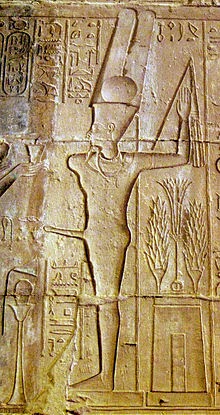
I have started 3 times to respond to the question about "Amen." Most recently, a few minutes ago, when my cell ran out of juice. The short answer is to google "Amen." Then, read to your heart's content, Lisa Dunn, Katherine Kirs, or anyone else interested. I am no oracle or priest of Amen, Amon, Aton, Atum, Ra, Ptah in the strictest of senses. I am a follower of Jesus Christ, who spared my life anew in 1992, in the broadest of senses. Even so, you have asked. So, I must answer. God has many names. Amen is one of them in the Bible; there are others. The Jews trace themselves to Abraham, as do the Christians and Arabs. Abram became Abraham after his sojourn in Egypt, which was symbolically similar to Joseph's, Jacob's, Moses', and Jesus'. Jewish identity and religion is inseparable from Mizraim, Egypt, Kemet, the Land of Ham, the black man's land--Others being Cush, Canaan, Libya, and Phut; also by extension through Nimrod, the land between the two rivers, Mesopatamia/Sumeria/Babylon/Assyria. Now the Jews took the name Amun or Amon and it became Amen through trasliteration. Similarly these black gods became the Greeks', too, as written by Homer and Plato and Herodotus. Again, read and study and learn for yourself. Thanks again.
Subscribe to:
Posts (Atom)